Content strategy
Content Repurposing vs Amplification Explained

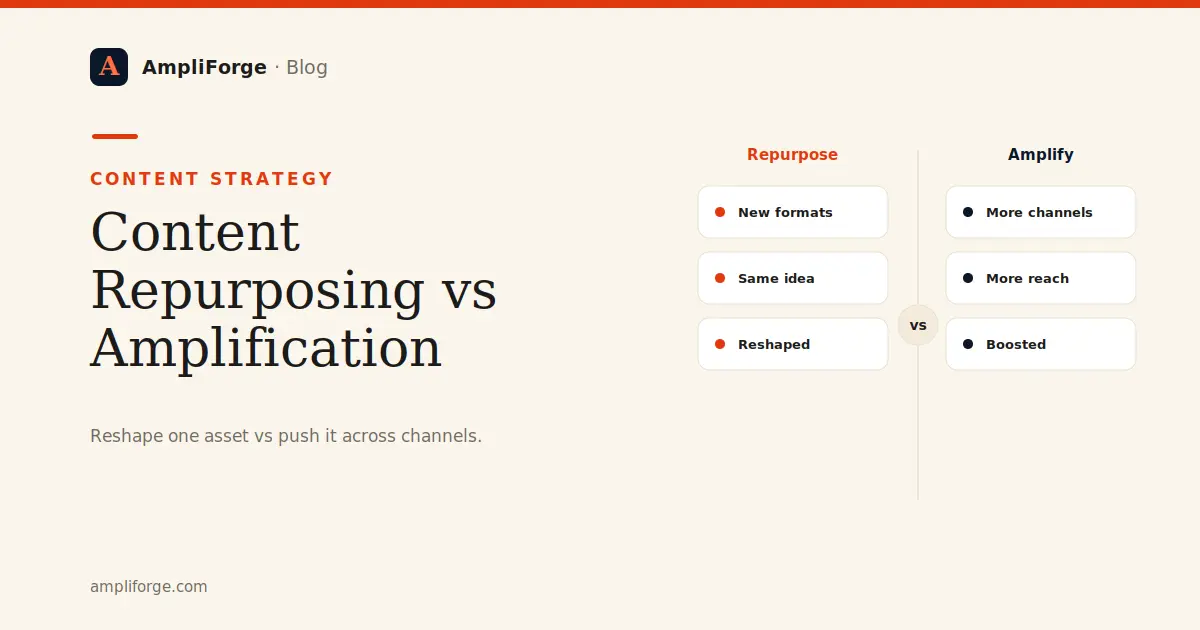
Content repurposing reshapes one source asset into new formats, while content amplification distributes an asset across channels and audiences to maximize reach. Repurposing changes the form; amplification changes the reach. The most efficient content operations do both, in that order, turning a single source into sustained visibility.
Marketing leaders often use "repurposing" and "amplification" as if they were the same tactic. They are not. One changes the shape of your content; the other changes how far it travels. Understanding the difference — and how the two connect — is the fastest way to get more value from every asset you already own.
The short answer: content repurposing reshapes one source asset into new formats, while content amplification distributes an asset across channels and audiences to maximize reach. Repurposing changes the form. Amplification changes the reach. The most efficient content operations do both, in that order.
What is content repurposing?
Content repurposing is the practice of taking a single source asset — a webinar, podcast, video, long-form article, or internal document — and reworking it into multiple new formats. The underlying idea stays the same; the packaging changes to fit a different context or audience.
A one-hour webinar, for example, can become a written recap, a how-to article, a short highlight video, a carousel, a checklist, and a dozen social posts. Each artifact stands on its own, yet all of them trace back to the same original recording. This is why teams describe repurposing as "atomising" a source: breaking one large asset into many smaller, self-contained pieces that each carry a single clear idea.
Repurposing matters because most B2B content is under-used. A team invests days producing a webinar, publishes the replay once, and moves on. The insight inside that recording could have fuelled a month of content. The waste is rarely a lack of ideas — it is a lack of packaging. If you want a concrete walk-through, see how to turn one webinar into 20 content pieces.
Good repurposing is not copy-paste. Each format has its own conventions: a LinkedIn post rewards a strong opening line, an article rewards structure and depth, a short video rewards a single clear idea, a checklist rewards brevity. The craft lies in preserving the substance while adapting the form. A repeatable B2B content repurposing framework keeps that adaptation consistent instead of ad hoc, so quality does not depend on who happens to be doing the work that week.
What types of repurposing exist?
Repurposing generally takes three shapes. Format change keeps the message but switches the medium — a recorded talk becomes a written article. Segmentation breaks a long asset into standalone parts — one webinar section becomes one focused post. Re-angling reframes the same material for a different audience or stage of the buying journey — a technical deep-dive becomes an executive summary. Most strong content programs use all three.
What repurposing is not
Repurposing is not simply reposting the same asset in the same format. Sharing a blog link three times is distribution, not repurposing. Repurposing produces a genuinely new artifact — different length, different medium, or different angle — from the same source material. That distinction matters, because it is exactly where repurposing ends and amplification begins.
What is content amplification?
Content amplification is the practice of pushing an existing asset across channels and audiences so that more of the right people see it. The asset itself does not change. What changes is its distribution: where it appears, how often, and to whom.
Amplification spans several motions. Organic amplification means posting to owned channels — your newsletter, LinkedIn, a community you run. Earned amplification means others share, cite, or link to your work. Paid amplification means putting budget behind a piece to extend its reach beyond your existing audience. Advocacy — employees and executives resharing to their own networks — sits between organic and earned, and often carries more trust than a brand account ever could.
The goal of amplification is reach and frequency, not new formats. A single strong article might be amplified through a newsletter send, three LinkedIn posts over two weeks, a paid promotion to a lookalike audience, and a mention in a partner's roundup. Same asset, many touchpoints. Buyers rarely act on a first exposure, so repeated, well-timed contact with the same idea is a feature of amplification, not a bug.
Amplification is where cadence matters most. Publishing once and hoping is not amplification; a deliberate schedule is. Building a LinkedIn cadence from long-form content is one of the highest-leverage amplification habits for B2B teams, because it keeps a single asset in front of an audience across multiple exposures without demanding new production each time.
Why amplification is often the weak link
Many teams over-invest in creation and under-invest in distribution. They produce excellent assets, publish them once, and never give them the reach they deserve. The imbalance is understandable — creation feels like the "real" work — but it quietly caps the return on every asset. Amplification fixes the imbalance: it treats distribution as a discipline with its own plan, its own calendar, and its own metrics, not an afterthought bolted on at the end.
How do repurposing and amplification work together?
Repurposing and amplification are sequential, not competing. Repurposing multiplies the number of assets you have; amplification multiplies the reach of each one. Do the first, then the second, and a single source can sustain weeks of visibility from a single afternoon of recording.
Consider the flow. You record a webinar — the source. You atomise it into an article, a checklist, three short videos, and ten social posts — repurposing. You then distribute each of those artifacts across your newsletter, LinkedIn, paid channels, and partner networks on a deliberate schedule — amplification. One hour of source material becomes a month of coordinated presence, and every piece points back to the same core message.
The table below shows the practical differences at a glance.
| Dimension | Content repurposing | Content amplification |
|---|---|---|
| Goal | Get more formats from one source asset | Get more reach for an existing asset |
| What it changes | The form: medium, length, and angle | The distribution: channels, frequency, and audience |
| Example | A webinar becomes an article, a checklist, and ten social posts | One article is shared via newsletter, LinkedIn, and paid promotion |
| Typical tools | Transcription, editing, an AI content engine, a brand-voice model | Scheduling, social publishing, paid ads, advocacy platforms |
| When to use | When one asset holds more value than a single format can carry | When a strong asset is not reaching enough of the right people |
Notice that the tools overlap but are not identical. Repurposing leans on extraction and generation; amplification leans on scheduling and channel management. A content operating system such as AmpliForge connects both stages, so a source asset flows from extraction and generation straight into a distribution queue with attribution attached — rather than living in separate, disconnected apps that never talk to each other. When AI is part of that flow, personal data should be redacted before any third-party model call, which keeps the efficiency without exposing customer information.
A simple sequence to follow
- Source. Start with one substantial asset — a webinar, podcast, or long article.
- Atomise. Repurpose it into several formats, each adapted to its channel.
- Voice. Ensure every piece sounds like your brand, not a generic template.
- Distribute. Amplify each artifact across channels on a planned cadence.
- Attribute. Track which pieces and channels drive results, using CTA and UTM data.
This is the logic behind a modern content supply chain: treat content as a flow from one source to many distributed, measured outputs, rather than a series of one-off publishing events. Attribution closes the loop, because it tells you which repurposed formats and which amplification channels actually moved pipeline — so the next cycle is sharper than the last.
Common mistakes to avoid
Two failure patterns show up repeatedly. The first is repurposing without amplification: teams generate dozens of assets, then dump them into a channel without a plan, and reach stays flat. The second is amplification without repurposing: teams push the same single format so relentlessly that the audience tunes it out. Both waste the source. The fix in each case is to restore the missing half of the pair.
Putting it together
Repurposing without amplification leaves you with many assets that few people see. Amplification without repurposing leaves you distributing the same single format until your audience tunes out. The teams that win at content do both: they extract maximum value from each source, then give every resulting piece the reach it deserves.
For B2B marketing leaders working without a large content team, the combined approach is especially powerful. It turns a single expert conversation into weeks of on-brand, measurable output — without proportionally more effort. That leverage is the whole point: fewer inputs, more outputs, all traceable. If you want to see how a connected content operating system handles both stages in one flow, compare the approaches.
Start with your next webinar or podcast. Repurpose it into five formats, amplify each on a two-week schedule, and measure what moves. That single discipline, repeated, compounds into a content engine that keeps working long after the recording ends.
Frequently asked questions
Should I repurpose or amplify first?
Repurpose first, then amplify. Reshaping a source into several formats gives you more assets to distribute, and amplification then extends the reach of each one. Doing them in that order maximizes the value of a single source.
Is it safe to use AI to repurpose content under EU rules?
Yes, when the workflow is built for it. A compliant setup redacts personal data before any third-party AI call and keeps processing within EU data residency under an Art. 28 GDPR data processing agreement. AI-assisted content should also be labelled where the EU AI Act Article 50 applies.
How many formats should one asset become?
There is no fixed number, but a substantial webinar or podcast can reasonably yield five to twenty pieces across articles, video, and social. Start with a handful of high-quality formats rather than flooding every channel at once.
Ralf Paschen
Founder, AmpliForge GmbH
Ralf Paschen is the founder of AmpliForge GmbH, the software company behind the AmpliForge platform. During three CMO appointments across enterprise B2B SaaS organizations, he encountered the same recurring problem: strong content was created once and then left underused, repeatedly rebuilt from scratch rather than repurposed across channels and formats. That gap became the founding premise for AmpliForge. Before founding the company, Ralf spent more than 20 years in enterprise software go-to-market roles across the US, EMEA, and DACH markets, including senior positions at Broadcom, CA Technologies, Automic, and Novell. His track record includes 25% revenue growth and 30% pipeline growth at Broadcom, 60% of marketing-sourced pipeline at xtype, and an earlier 300% increase in lead generation at an enterprise software business. Ralf holds an MIT Professional Education certification in Designing and Building AI Products and Services, which informs AmpliForge's approach to applying artificial intelligence to content repurposing at scale. He is the author of Stop Prompting, available on Amazon.