Distribution
Build a LinkedIn Cadence From Long-Form Content

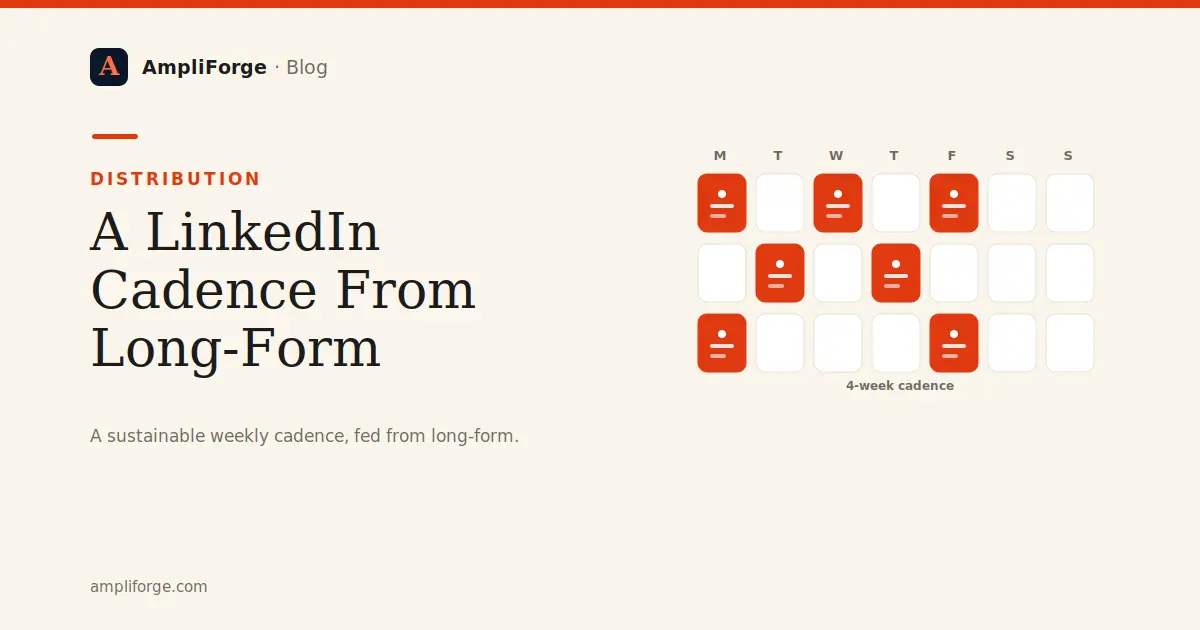
A B2B LinkedIn cadence is the fixed weekly rhythm at which your company or founder profile publishes. For most B2B SaaS teams, three to five posts per week is realistic and sustainable — provided each post is fed from long-form content you already own, not written from a blank page every morning.
A B2B LinkedIn cadence is the fixed weekly rhythm at which your company page or founder profile publishes. For most B2B SaaS teams, three to five posts per week is realistic and sustainable — but only when each post is fed from long-form content you already own, instead of being written from a blank page every morning. This guide shows the cadence that actually holds up, and exactly how to fill it.
What is a realistic B2B LinkedIn cadence?
The honest answer most teams need to hear: the right cadence is the one you can sustain for six months, not the one that looks impressive for three weeks. Daily posting is a fine goal for a dedicated creator, but it is the wrong target for a marketing lead who also owns demand gen, events, and the website.
For B2B SaaS companies at Series A to B, a workable baseline looks like this:
- Founder profile: three to four posts per week. Personal profiles get materially more reach than company pages, so this is where thought leadership lives.
- Company page: two to three posts per week, often reshares or amplifications of the founder's posts plus product and customer stories.
- Rhythm over volume: the same three weekdays every week beats a random burst of seven followed by silence. The algorithm and your audience both reward predictability.
Frequency only becomes a problem in one direction. Posting much more than once a day can suppress the reach of your previous post before it has finished circulating. The practical ceiling for most B2B accounts is one post per day; the practical floor, if you want compounding visibility, is about two per week.
Timing matters less than people fear, but a simple default works: post on weekday mornings in your buyers' time zone, Tuesday through Thursday for your highest-stakes pieces, and keep Monday and Friday for lighter formats. Do not over-optimize the clock at the expense of the calendar — a consistently published post at an average time beats a perfectly timed post that never ships.
Why the blank page is the real bottleneck
Almost every stalled LinkedIn cadence fails for the same reason: it depends on someone inventing a new idea each morning. That is unsustainable. A cadence you can keep is not a discipline problem — it is a supply problem. Fix the supply of raw material and the consistency follows.
Why start from long-form content instead of a blank page?
You almost certainly already produce long-form assets: a webinar, a podcast episode, a customer interview, a pillar blog post, a conference talk, a product deep-dive. Each of these contains a week's worth of individual ideas. Repurposing is simply the discipline of pulling those ideas out and reshaping them for the feed.
At AmpliForge we describe this as a repeatable pipeline — Source → Atomise → Voice → Distribute → Attribute. You take one source asset, atomise it into its smallest defensible ideas, rewrite each in your brand voice, distribute them on a schedule, and attribute the pipeline they generate. For the full method, see our B2B content repurposing framework, and for a worked example of volume, how to turn one webinar into 20+ content pieces.
This is repurposing, not amplification — and the difference matters for how you plan a cadence. Repurposing creates the supply; amplification decides how hard you push each piece. If the distinction is fuzzy, our note on content repurposing vs amplification untangles it.
What mix of formats should a week contain?
Cadence is not only about frequency; it is about variety. A healthy week mixes at least three formats so the feed does not see the same shape from you every day:
- Text posts — your reach and opinion workhorse.
- Carousels (document posts) — for frameworks and step-by-step value; strong on saves and dwell time.
- Polls — low-effort engagement that doubles as audience research.
- Single-image or quote posts — fast to produce, good for proof points and one-liners.
Rotating formats keeps the account from feeling repetitive and gives each atomic idea the shape that suits it best — a five-step model belongs in a carousel, a sharp opinion belongs in text.
A week of posts from one long-form asset
Take a single 40-minute webinar. Before you write anything, list the atomic ideas inside it: the core argument, each framework step, the strongest data point, a memorable customer quote, the most common objection, and the "what surprised us" moment. That list is your week.
A clean five-post week from one webinar might look like this:
- Monday — the contrarian hook (text). Lead with the one belief the webinar challenges. Pure text posts are your workhorse for reach.
- Tuesday — the framework (carousel). Turn the webinar's core model into a slide-by-slide carousel. Saves and dwell time are strong signals here.
- Wednesday — the poll. Ask the question the webinar opened with. Polls are low-effort, high-engagement, and they surface the language your audience uses.
- Thursday — the proof (text or single image). Share the strongest result or data point, with the context that makes it credible.
- Friday — the human angle (text). A short, first-person reflection on what surprised you. Lighter, more personal, built for comments.
Notice that one asset filled an entire week without a single blank page — and you still have quotes and objections left over. That surplus is what makes the cadence durable: you are always working from a backlog, never from zero.
A sample 4-week LinkedIn calendar
Here is the centerpiece: a four-week cadence in which every week is fed by one long-form asset you already own. Rows are weeks (with their source asset); columns are posting days. Each cell names the repurposed piece and its format.
| Week (source asset) | Monday | Tuesday | Wednesday | Thursday | Friday |
|---|---|---|---|---|---|
| Week 1 40-min product webinar | Contrarian hook (text) | 5-step framework (carousel) | Poll: the opening question | Strongest result (text + image) | "What surprised us" (personal text) |
| Week 2 1,500-word pillar article | Core thesis, reframed (text) | Myth vs reality (carousel) | Poll: readers' biggest blocker | One tactic, step by step (text) | Behind the article (personal text) |
| Week 3 Customer interview / podcast | Customer's contrarian lesson (text) | Before/after story (carousel) | Poll: your version of the problem | Best quote as a proof point (image) | What we learned (personal text) |
| Week 4 Quarterly benchmark report | Headline stat + take (text) | Three charts that matter (carousel) | Poll: where do you land vs the benchmark? | A surprising finding (text) | How we ran the numbers (personal text) |
Four assets — one webinar, one pillar article, one customer interview, one benchmark report — produced twenty posts across four weeks. Friday is deliberately lighter and more personal, which keeps the week sustainable and gives the algorithm a human signal to reward. When week four ends, you rotate back to a fresh source and repeat.
How do you know the cadence is working?
Consistency is the input; pipeline is the output. Vanity metrics like impressions tell you the cadence is running, not whether it is producing revenue. Tag the links in your posts with UTM parameters and tie them back to a clear call to action so you can see which repurposed angles actually drive demos and signups. Our guide to measuring content ROI with CTA and UTM attribution covers the setup. Over a few weeks you will learn which source assets and which formats earn their place in the calendar.
Keeping the cadence compliant and on-brand
If you use AI to help atomise and draft — as most lean teams now do — two guardrails matter for EU B2B. First, privacy: AmpliForge redacts personally identifiable information before every third-party AI call, so customer names and contact details in a webinar transcript never travel to an external model in the clear. This is redaction before processing; you should not assume third-party models never train on inputs, so controlling what you send is the reliable safeguard. Second, transparency: AI-assisted content should be labeled in line with EU AI Act Article 50 where it applies. A cadence you can defend is worth more than one you have to explain.
The takeaway: stop treating LinkedIn as a daily writing task and start treating it as a distribution channel for content you already produce. Fix the supply, set a rhythm you can hold, and let one long-form asset carry a full week.
Frequently asked questions
How often should a B2B company post on LinkedIn?
For most B2B SaaS teams, three to five times per week is the sweet spot: frequent enough to stay visible in the feed, sustainable enough to maintain for months. Consistency matters more than volume — two reliable posts a week beat seven followed by silence.
How do you turn a blog post or webinar into LinkedIn posts?
Extract the atomic ideas — each key point, stat, framework step, quote, or objection becomes one post. A single 40-minute webinar or 1,500-word pillar article comfortably yields eight to fifteen distinct posts across text, carousel, and poll formats.
Is it GDPR-compliant to use AI to draft LinkedIn posts?
Yes, when personal data is handled correctly. AmpliForge redacts personally identifiable information before every third-party AI call and operates under EU data residency and an Art. 28 GDPR data processing agreement. AI-assisted posts should also carry EU AI Act Art. 50 transparency where it applies.
Ralf Paschen
Founder, AmpliForge GmbH
Ralf Paschen is the founder of AmpliForge GmbH, the software company behind the AmpliForge platform. During three CMO appointments across enterprise B2B SaaS organizations, he encountered the same recurring problem: strong content was created once and then left underused, repeatedly rebuilt from scratch rather than repurposed across channels and formats. That gap became the founding premise for AmpliForge. Before founding the company, Ralf spent more than 20 years in enterprise software go-to-market roles across the US, EMEA, and DACH markets, including senior positions at Broadcom, CA Technologies, Automic, and Novell. His track record includes 25% revenue growth and 30% pipeline growth at Broadcom, 60% of marketing-sourced pipeline at xtype, and an earlier 300% increase in lead generation at an enterprise software business. Ralf holds an MIT Professional Education certification in Designing and Building AI Products and Services, which informs AmpliForge's approach to applying artificial intelligence to content repurposing at scale. He is the author of Stop Prompting, available on Amazon.