Content strategy
A B2B Content Repurposing Framework That Scales

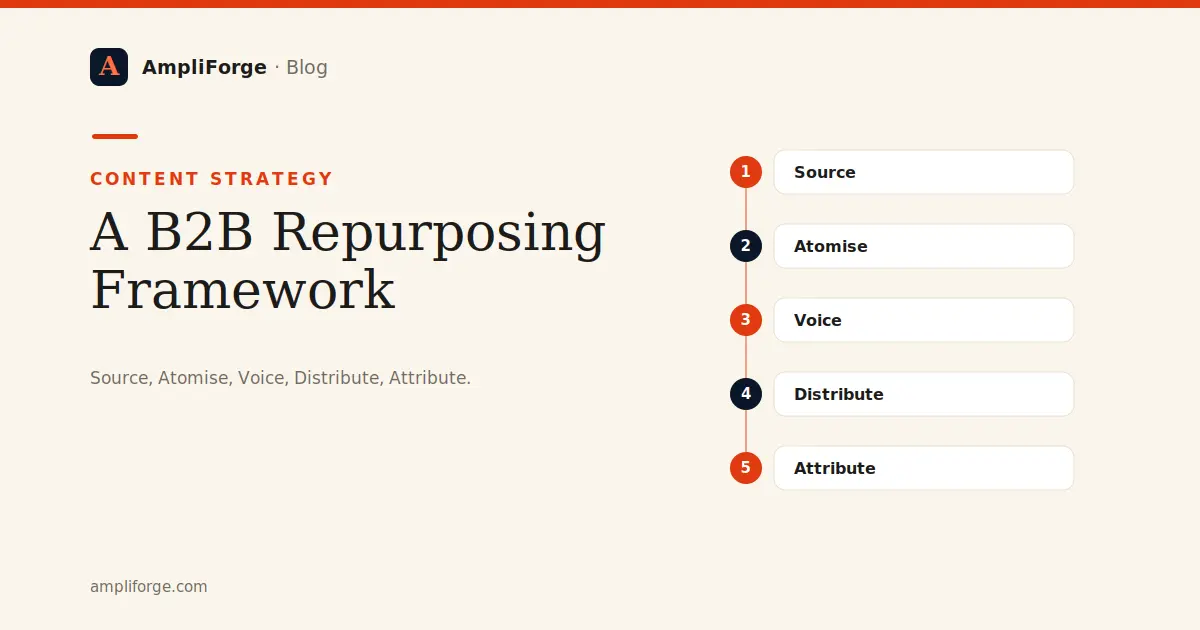
A content repurposing framework is a repeatable process for turning one substantial source asset into many distribution-ready pieces without diluting quality. The strongest B2B frameworks run five stages — Source, Atomise, Voice, Distribute, Attribute — so every derived post stays on-brand, reaches the right channel, and ties back to measurable pipeline.
A content repurposing framework is a repeatable process for turning one substantial source asset into many distribution-ready pieces without diluting quality. The strongest B2B frameworks run five stages — Source, Atomise, Voice, Distribute, Attribute — so every derived post stays on-brand, reaches the right channel, and ties back to measurable pipeline.
Most B2B SaaS teams already produce enough raw material. A single webinar, a customer interview, a founder's conference talk, a detailed product update — each one holds weeks of content. The bottleneck is rarely ideas. It is the absence of a system that reliably converts one asset into many without a heroic manual effort every single week.
This article defines that system: a named, five-stage framework you can copy, run, and hold your team to — even when that team is one person. It sits inside the broader idea of a content supply chain, but it is narrow enough to start using this week.
What makes a repurposing framework work at scale?
Plenty of teams already "repurpose." They clip a webinar quote, paste it into LinkedIn, and move on. That is reuse, not a framework — and it stalls the moment the person doing it gets busy. Three things separate a framework that scales from ad hoc reuse.
- One source of truth. Every derived piece traces back to a single approved asset. This keeps facts consistent and stops the slow drift where the tenth post says something the original never claimed.
- Consistency by design, not by editing. Brand voice, claims, and terminology are enforced at generation time. If consistency depends on a human catching every deviation in review, it will not survive volume.
- A measurement loop. Each piece carries a link back to a goal — a demo, a guide, a signup — so you learn which angles actually move pipeline and can double down instead of guessing.
A framework that has all three lets output scale with the number of source assets, not with the number of hours a marketer can personally spend. That is the whole point: decouple volume from heroics.
The 5 stages: Source, Atomise, Voice, Distribute, Attribute
Here is the framework. Treat the five stages as a numbered pipeline — each stage takes the output of the previous one and hands off a cleaner artifact to the next.
Stage 1 — Source: pick one asset dense enough to mine
What it does: selects the single input everything else derives from. How to run it: favor assets with high idea density and a clear point of view — a recorded webinar, a customer interview, a sales-call teardown, an internal strategy memo, or a founder's talk. A transcript beats a polished blog post as a source, because raw talk contains the offhand insights and specific examples that make derived content feel human. Choose one asset per cycle and commit to it. Trying to atomise five thin assets at once produces thin content five times over.
Stage 2 — Atomise: break the asset into standalone ideas
What it does: decomposes the source into the smallest self-contained units of value — a claim, a framework, a counter-intuitive example, a mistake, a number. How to run it: read or scan the transcript and list every idea that could stand on its own without the rest of the asset. Aim for 15 to 25 atoms from a substantial source. Each atom should pass one test: could a reader get value from this alone, without watching the original? Atoms are format-agnostic at this stage — you are capturing ideas, not writing posts yet. This is the step most teams skip, and it is why their repurposing feels like the same point restated five ways.
Stage 3 — Voice: rewrite each atom in your brand voice
What it does: turns raw atoms into on-brand copy that sounds like your company, not like a generic model. How to run it: this is where retrieval-augmented generation (RAG) earns its place. Ground the rewrite in your own past content, style guide, and approved messaging so tone, terminology, and claims stay consistent across dozens of pieces. AmpliForge builds a brand-voice model from your existing material via RAG and applies it at generation time — and, because privacy is a first-class concern in the EU, it redacts personally identifiable information before any third-party AI call, so customer data is stripped before it leaves your environment. Voice consistency is what makes twenty derived posts read as one coherent brand rather than twenty experiments.
Stage 4 — Distribute: format and schedule per channel
What it does: shapes each on-brand atom into a channel-native format and puts it in a queue. How to run it: an idea is not a post until it fits where it lands. The same atom becomes a LinkedIn hook-and-story, a paragraph in a newsletter, a short quote card, or a 40-second video caption. Match format to channel, then schedule for a sustainable cadence rather than dumping everything at once. If your primary channel is LinkedIn, plan a realistic rhythm — see building a LinkedIn cadence from long-form content — and let one source asset feed several weeks. For a worked example of the full expansion, see how to turn one webinar into 20 content pieces.
Stage 5 — Attribute: connect every piece to pipeline
What it does: closes the loop by tying published content to measurable outcomes. How to run it: every distributed piece should carry a purposeful call to action and a tracked link — consistent UTM parameters plus a clear CTA destination — so you can see which atoms, angles, and channels generate clicks, signups, and pipeline. Attribution is what turns repurposing from an activity into an investment you can defend in a board meeting. For the mechanics, see how to measure content ROI with CTA and UTM attribution.
The five stages summarized:
| Stage | What it does | Output |
|---|---|---|
| 1. Source | Pick one idea-dense asset | An approved source transcript or asset |
| 2. Atomise | Break it into standalone ideas | 15–25 format-agnostic atoms |
| 3. Voice | Rewrite atoms on-brand via RAG | On-brand draft copy |
| 4. Distribute | Format and schedule per channel | A queued, channel-native content calendar |
| 5. Attribute | Tie each piece to pipeline | CTA- and UTM-tagged links with reporting |
How do you run it as a team of one?
The framework is deliberately survivable by a single marketer. The trick is to batch by stage, not by piece — running all of Stage 2 for one asset, then all of Stage 3, is far faster than perfecting one post end to end and repeating twenty times.
A realistic weekly rhythm looks like this:
- Monday: choose the week's source asset and atomise it into a list of ideas (Stages 1–2).
- Tuesday: run the atoms through your brand voice and lightly edit (Stage 3).
- Wednesday: format the strongest atoms for each channel and load the queue (Stage 4).
- Ongoing: publish on cadence, and each month review attribution to see which angles earned pipeline (Stage 5).
Doing this by hand across separate tools is possible, but the seams — copying between an AI writer, a scheduler, and a spreadsheet of UTMs — are where a solo operator loses the whole afternoon. That integration cost is exactly why a single connected system tends to beat a stack of point tools; the trade-offs are worth understanding before you commit, which is why it helps to compare a content operating system against point tools.
AmpliForge runs this framework end to end as a content operating system: it extracts and atomises a source asset, generates on-brand copy through a RAG brand-voice model with PII redacted before every third-party AI call, feeds a LinkedIn publishing queue, and reports CTA and UTM attribution — with EU data residency and an Art. 28 GDPR data processing agreement built in. Whether you run the five stages manually or automate them, the framework is the same. Start with one asset, atomise honestly, protect your voice, distribute where your buyers actually are, and attribute everything. Do that for a quarter and repurposing stops being a chore and becomes your most defensible content channel.
Frequently asked questions
What is a good content repurposing framework for B2B?
A good B2B framework is repeatable and channel-aware, not a one-off. Run five stages: Source (choose one dense asset), Atomise (break it into standalone ideas), Voice (rewrite each idea in your brand voice), Distribute (format and schedule per channel), and Attribute (tie every piece back to pipeline with CTA and UTM tracking).
How many pieces can one source asset realistically produce?
A 45-minute webinar or a substantial customer interview typically yields 15 to 25 usable pieces: several LinkedIn posts, a long-form article, a handful of short quotes and takeaways, an email section, and a couple of short-form video clips. The number depends on how idea-dense the source is, not on how hard you push a single point.
Is it GDPR-compliant to repurpose content with AI tools?
It can be, if the tooling is built for it. Look for EU data residency, an Art. 28 GDPR data processing agreement, and PII redaction before any third-party AI call so personal data is stripped before it leaves your environment. Under EU AI Act Art. 50, clearly label AI-assisted content. AmpliForge redacts PII before every model call and does not train its own models on customer data.
Ralf Paschen
Founder, AmpliForge GmbH
Ralf Paschen is the founder of AmpliForge GmbH, the software company behind the AmpliForge platform. During three CMO appointments across enterprise B2B SaaS organizations, he encountered the same recurring problem: strong content was created once and then left underused, repeatedly rebuilt from scratch rather than repurposed across channels and formats. That gap became the founding premise for AmpliForge. Before founding the company, Ralf spent more than 20 years in enterprise software go-to-market roles across the US, EMEA, and DACH markets, including senior positions at Broadcom, CA Technologies, Automic, and Novell. His track record includes 25% revenue growth and 30% pipeline growth at Broadcom, 60% of marketing-sourced pipeline at xtype, and an earlier 300% increase in lead generation at an enterprise software business. Ralf holds an MIT Professional Education certification in Designing and Building AI Products and Services, which informs AmpliForge's approach to applying artificial intelligence to content repurposing at scale. He is the author of Stop Prompting, available on Amazon.