Content strategy
What Is a Content Supply Chain? A Guide for B2B SaaS

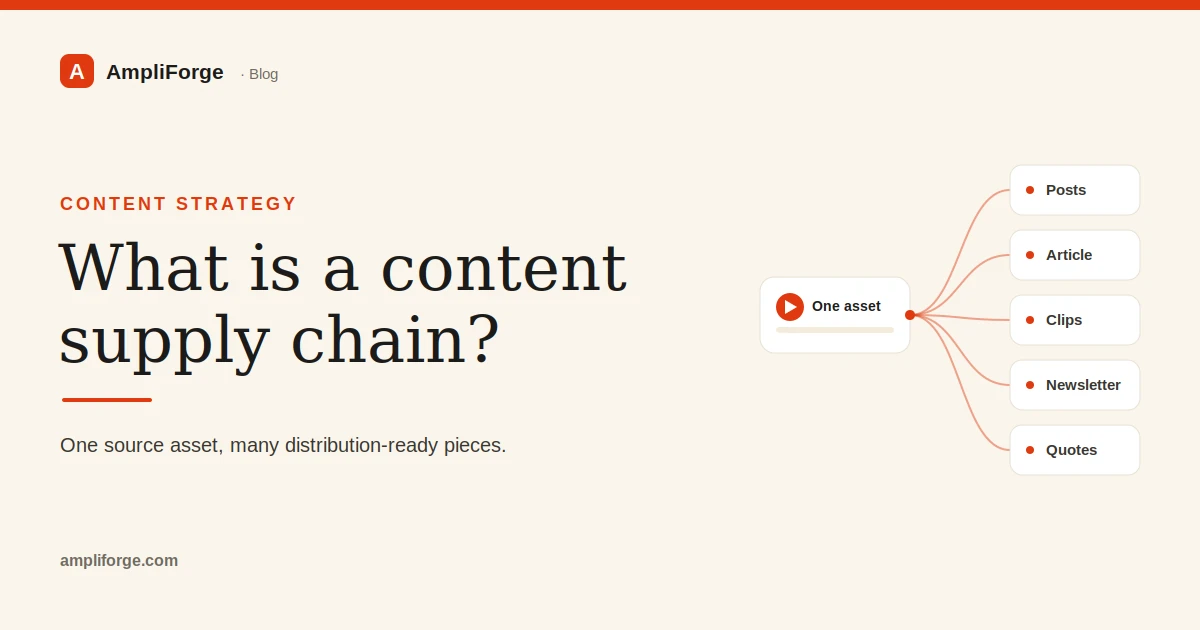
A content supply chain is the end-to-end system a marketing team uses to turn one source asset — a webinar, podcast or document — into many distribution-ready pieces across channels, and then measure their impact. It treats content like a supply chain: source, produce, distribute, and account for results.
Most B2B marketing teams do not have a content creation problem. They have a content utilization problem. A webinar is produced once, watched by a few hundred people, and archived. A podcast episode reaches the people who already subscribe. A detailed research document is used in one deal and then forgotten. The ideas were valuable — they simply never traveled.
A content supply chain is the system that fixes this. Borrowed from manufacturing, the term describes an end-to-end process for turning raw material — a source asset — into many finished, distribution-ready pieces, then getting them to the right channels and measuring what they produced. This guide explains what a content supply chain is, the stages it runs through, and why lean B2B SaaS teams increasingly organize their marketing around one.
What is a content supply chain (and what it isn't)?
A content supply chain is the end-to-end system a team uses to source, produce, distribute and account for content. Instead of treating every deliverable as a one-off project that starts from a blank page, it treats content like a supply chain: a repeatable flow that takes one input and reliably produces many outputs.
Concretely, a single source asset — say, a 45-minute customer webinar — enters the chain and comes out the other side as a set of LinkedIn posts, a long-form article, a newsletter, short video clips, quote cards and a sales follow-up, each ready to publish. The same idea is expressed in the formats each channel and audience prefers, rather than being rebuilt from scratch every time.
It helps to be clear about what a content supply chain is not. It is not a digital asset management (DAM) system, which stores and organizes files you already have. It is not a content management system (CMS), which publishes pages. And it is not simply "content operations", the broader discipline of planning and governing content work. A content supply chain is the productive spine that runs through all of these: the mechanism that converts a source into distributed, measured output.
What are the stages of a modern content supply chain?
A modern content supply chain runs through five to six distinct stages. Naming them makes the process repeatable — and makes it obvious where most teams break the chain.
1. Source
Every chain starts with a source asset: a webinar, podcast, video, interview, document, or even a single URL. The best sources are things the business already produces in the ordinary course of work, so the chain adds leverage rather than more production burden.
2. Extract
Raw material has to be broken down before it can be reused. Extraction means pulling the key insights, arguments, quotes, statistics and frameworks out of the source — the atomic units of value that individual pieces of content will be built around.
3. Generate
Each extracted idea is then generated into the formats different channels reward: short social posts, carousels, an article, a newsletter section, a clip. The critical requirement here is brand voice — output that sounds like the company, not like generic AI. For how this works technically, see our guide to brand-voice AI and RAG.
4. Distribute
Content that is not published does not exist. Distribution covers scheduling and publishing each piece to its channel — LinkedIn, a blog, email — and doing so on a sustainable cadence rather than in bursts.
5. Analyze
Once content is live, the chain measures how each piece performed: reach, engagement, and which formats and topics resonate. This closes the loop and tells the team what to source and extract next.
6. Attribute
The most mature content supply chains go one step further and connect content to revenue — using CTA tracking and UTM parameters to show which pieces drove clicks, pipeline and, ultimately, deals. Attribution is what turns content from a cost center into a measurable growth channel.
Why do lean B2B SaaS teams need one?
Three shifts have made the content supply chain essential for small B2B marketing teams in particular.
Distribution, not creation, is the bottleneck. AI has made producing a first draft nearly free. The scarce resource is now the disciplined process of turning one good idea into a week of on-brand, on-channel content — and actually shipping it. A supply chain is that process.
Small teams cannot afford waste. A team of one or two cannot rebuild content from scratch for every channel. Getting 20–40 pieces from a single asset is the difference between a credible content presence and an empty calendar.
Buyers and AI assistants both reward consistency. A steady flow of substantive, well-structured content compounds — in search rankings, in LinkedIn reach, and increasingly in whether AI answer engines cite you at all. One-off campaigns do not compound; a supply chain does.
For teams operating in the EU there is a further consideration: where the content — and the personal data inside it — is processed. A content supply chain that runs on EU infrastructure for transcription and storage, and redacts personal names and identifiers before any AI call, keeps personal data inside a boundary you control — regardless of which model ultimately generates the output.
From concept to practice
A content supply chain is less a piece of software than a way of organizing content work: source once, extract the value, generate many formats in your voice, distribute them, and account for the results. Teams that adopt it stop asking "what should we post today?" and start asking "what did we already make that we haven't fully used?"
For the step-by-step version, our B2B content repurposing framework turns these stages into a repeatable playbook, and our guide to turning one webinar into 20+ pieces shows the chain applied to a single asset. To see how a dedicated platform compares with stitching point tools together, see how AmpliForge compares.
Frequently asked questions
What is a content supply chain?
A content supply chain is the end-to-end system for turning source material into distribution-ready content and measuring its impact. It spans sourcing an asset, extracting ideas, generating formats in your brand voice, distributing them across channels, and attributing results.
What are the stages of a content supply chain?
A modern content supply chain has five to six stages: source (ingest an asset), extract (pull the key ideas), generate (create formats in your brand voice), distribute (publish and schedule), analyze (measure performance), and attribute (connect content to pipeline).
How is a content supply chain different from content operations or a DAM?
Content operations and digital asset management focus on organizing and storing content you already have. A content supply chain is broader: it produces new derivative content from a source, then distributes and measures it — not just managing existing files.
Ralf Paschen
Founder, AmpliForge GmbH
Ralf Paschen is the founder of AmpliForge GmbH, the software company behind the AmpliForge platform. During three CMO appointments across enterprise B2B SaaS organizations, he encountered the same recurring problem: strong content was created once and then left underused, repeatedly rebuilt from scratch rather than repurposed across channels and formats. That gap became the founding premise for AmpliForge. Before founding the company, Ralf spent more than 20 years in enterprise software go-to-market roles across the US, EMEA, and DACH markets, including senior positions at Broadcom, CA Technologies, Automic, and Novell. His track record includes 25% revenue growth and 30% pipeline growth at Broadcom, 60% of marketing-sourced pipeline at xtype, and an earlier 300% increase in lead generation at an enterprise software business. Ralf holds an MIT Professional Education certification in Designing and Building AI Products and Services, which informs AmpliForge's approach to applying artificial intelligence to content repurposing at scale. He is the author of Stop Prompting, available on Amazon.