Content strategy
Content Operating System vs Point Tools

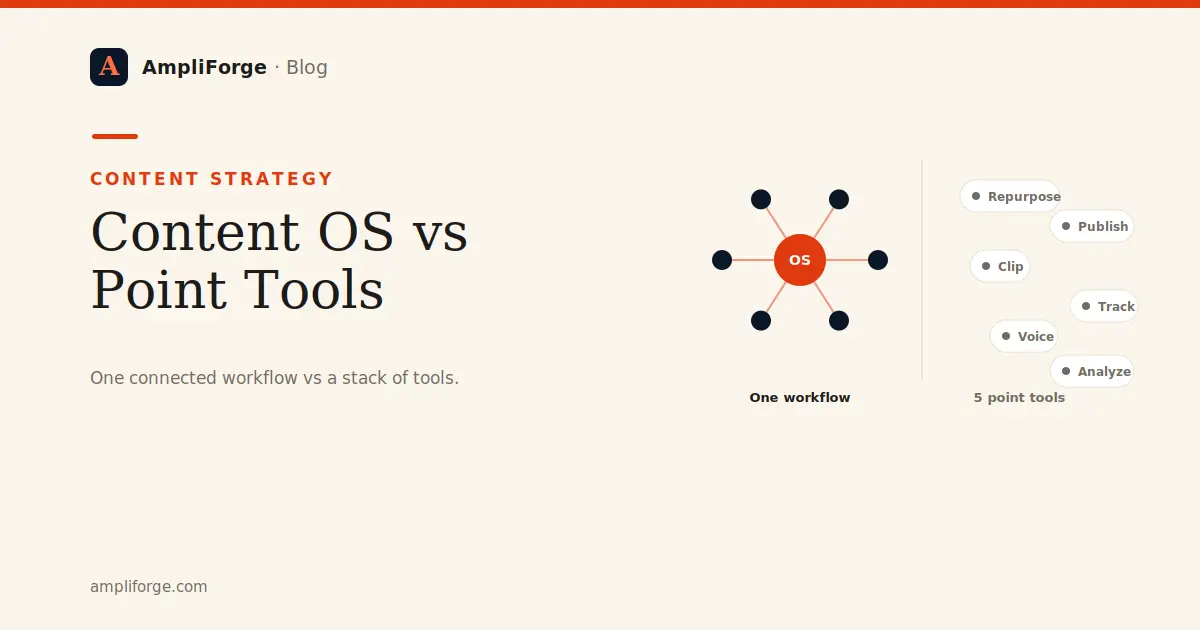
A content operating system is a single platform that runs your whole content workflow — turning one source asset into repurposed pieces, publishing them, and attributing results — instead of stitching separate point tools together. It replaces the glue work between tools with one connected pipeline: source, atomize, voice, distribute, attribute.
A content operating system is a single platform that runs your entire content workflow end to end: it ingests a source asset, repurposes it into many pieces in your brand voice, publishes them to your channels, and attributes the results back to revenue. Instead of a stack of point tools that each solve one step, a content OS connects every step in one pipeline — so the work no longer falls into the gaps between tools.
Most marketing teams did not choose a fragmented toolset on purpose. They adopted a transcription tool, then a repurposing tool, then a scheduler, then a link tracker — each a reasonable decision in isolation. The problem is the space between those decisions. This article explains what a content operating system is, where the hidden costs of a point-tool stack come from, and — fairly — when each approach actually wins.
What is a content operating system?
A content operating system is defined by one property: it owns the whole workflow, not a single task. Borrowing the term from computing, an operating system coordinates resources so applications do not each have to reinvent memory, files, and scheduling. A content OS does the same for content — it coordinates ingestion, generation, distribution, and measurement so no single step lives on an island.
In practice, a content operating system covers five stages:
- Source — ingest one substantial asset: a webinar, podcast, customer call, long document, or recorded talk.
- Atomize — break that asset into many distribution-ready pieces: posts, threads, summaries, clips, and email sections.
- Voice — generate every piece in your brand voice, not a generic model default. This is where retrieval-augmented generation (RAG) grounds output in your own prior content and messaging.
- Distribute — publish and queue those pieces on the channels that matter, starting with LinkedIn for most B2B teams.
- Attribute — tag every published piece with CTA and UTM data so you can trace which content produced pipeline and revenue.
This is the same pipeline we describe as a content supply chain: one raw input, many refined outputs, measured end to end. The operating-system framing simply emphasizes the software that runs it, rather than the process itself.
The hidden cost of stitching point tools together
A point tool is software that does one step of the workflow extremely well — transcription, clip generation, scheduling, or analytics. Point tools are often excellent at their one job. The cost is not the tools; it is the glue work between them: exporting, reformatting, re-uploading, copying links, and reconciling numbers across dashboards that were never designed to talk to each other.
This glue work is mostly invisible on a budget line, because it shows up as staff hours rather than a subscription. But it is real, and it compounds every week you publish. The table below maps where those hidden costs accumulate across a typical stack, compared with a single content operating system.
| Workflow stage | Point-tool stack | Content operating system |
|---|---|---|
| Repurposing | Transcript is exported from one tool and pasted into another; each format is prompted separately, with no memory of the source. | One source asset is atomized into all formats in a single pass, keyed to the same original. |
| Publishing | Finished pieces are copied into a separate scheduler; formatting and links are re-checked by hand. | Pieces flow straight into a publishing queue; no re-export step. |
| Attribution | UTMs are built manually in a spreadsheet; results live in an analytics tool disconnected from the content. | CTA and UTM tags are attached at publish time and reported against each piece. |
| Brand voice | Each generic AI tool starts from its default voice; consistency depends on whoever writes the prompt that day. | Brand voice is enforced through RAG grounded in your own content, across every piece. |
| EU compliance | Data residency and processing terms vary tool by tool; every new vendor is a separate GDPR review. | One EU-based platform, one Art. 28 GDPR DPA, one data-residency guarantee. |
| Integration / glue cost | Staff hours spent moving work between tools; breaks silently when any tool changes its export. | No hand-offs between steps; the pipeline is the integration. |
The pattern is consistent: every row in the point-tool column ends with a human moving data by hand. Each hand-off is a place where quality drops, links break, or a piece simply never gets published because the person who owned that step was out that week.
When does a content OS win (and when doesn't it)?
A content operating system is not automatically the right answer. The honest test is whether your bottleneck is a single capability or the connections between capabilities.
When a content operating system wins
- You publish continuously. The more often you turn source assets into distributed content, the more the glue work repeats — and the more a connected pipeline saves.
- You have a small team. For Series A–B B2B SaaS teams in the DACH region, often without a dedicated content function, the hand-offs between tools are exactly the work no one has time for.
- You need attribution. If you have to prove content's contribution to pipeline, tags applied at publish time beat a spreadsheet reconstructed after the fact. See measuring content ROI with CTA and UTM attribution.
- You operate under EU rules. One EU-based platform with a single DPA is far simpler to govern than a dozen vendors with different data-residency stories. See GDPR-compliant AI content and EU data residency.
- Brand consistency matters. RAG-grounded voice across every piece is hard to reproduce by manually prompting separate generic tools.
When point tools still win
- You need one best-in-class capability. If your entire strategy hinges on, say, the most advanced short-form video clipping on the market, a specialized point tool may beat any all-in-one on that single axis.
- Your volume is low. If you publish occasionally, the glue work is small and may not justify replacing tools your team already knows.
- You have deep existing investment. A team with mature, well-integrated tooling and the engineering support to maintain it may already have solved the connection problem in-house.
- Your workflow is genuinely unusual. A platform optimizes for a common pipeline; a highly idiosyncratic process can sometimes be served better by composable parts.
A useful rule: adopt a content operating system when the connections are your problem, and keep point tools when a single step is your problem. Many teams end up with a hybrid — a content OS as the backbone, with one or two specialist tools plugged in where a category leader genuinely outperforms.
How do you move from a stack to a content OS?
You do not need to rip everything out at once. The lowest-risk path is to consolidate the middle of the workflow first — repurposing and voice — because that is where the most hand-offs cluster. A structured method helps; our B2B content repurposing framework walks through the Source → Atomize → Voice → Distribute → Attribute sequence step by step.
Then bring distribution and attribution under the same roof, so the piece you generate is the piece you publish and the piece you measure — with no re-export in between. At that point the stack stops being a collection of tools and starts being a system.
AmpliForge is built as exactly this kind of EU-based content operating system, with PII redaction before every third-party AI call rather than a promise about model training. If you want to see how a connected pipeline compares with a stack of point tools for your team, explore the comparison or start from the homepage.
Frequently asked questions
What is a content operating system?
A content operating system is a single platform that manages the full content workflow — ingesting a source asset, repurposing it into many pieces in your brand voice, publishing them, and attributing results — instead of stitching separate point tools together.
Is an all-in-one content platform better than point tools?
Not always. Point tools can win when you need one best-in-class capability, like advanced video clipping. A content operating system wins when the cost of moving work between tools — the glue work — outweighs any single tool's edge.
Is a content operating system GDPR-compliant?
It depends on the vendor, not the category. AmpliForge is EU-based: transcription and storage run on EU infrastructure, it offers an Art. 28 GDPR data processing agreement, and it redacts personal data before any third-party AI call. Always confirm data residency and a DPA before adopting any platform.
Ralf Paschen
Founder, AmpliForge GmbH
Ralf Paschen is the founder of AmpliForge GmbH, the software company behind the AmpliForge platform. During three CMO appointments across enterprise B2B SaaS organizations, he encountered the same recurring problem: strong content was created once and then left underused, repeatedly rebuilt from scratch rather than repurposed across channels and formats. That gap became the founding premise for AmpliForge. Before founding the company, Ralf spent more than 20 years in enterprise software go-to-market roles across the US, EMEA, and DACH markets, including senior positions at Broadcom, CA Technologies, Automic, and Novell. His track record includes 25% revenue growth and 30% pipeline growth at Broadcom, 60% of marketing-sourced pipeline at xtype, and an earlier 300% increase in lead generation at an enterprise software business. Ralf holds an MIT Professional Education certification in Designing and Building AI Products and Services, which informs AmpliForge's approach to applying artificial intelligence to content repurposing at scale. He is the author of Stop Prompting, available on Amazon.