AI & content
Brand-Voice AI & RAG: How It Works for Content

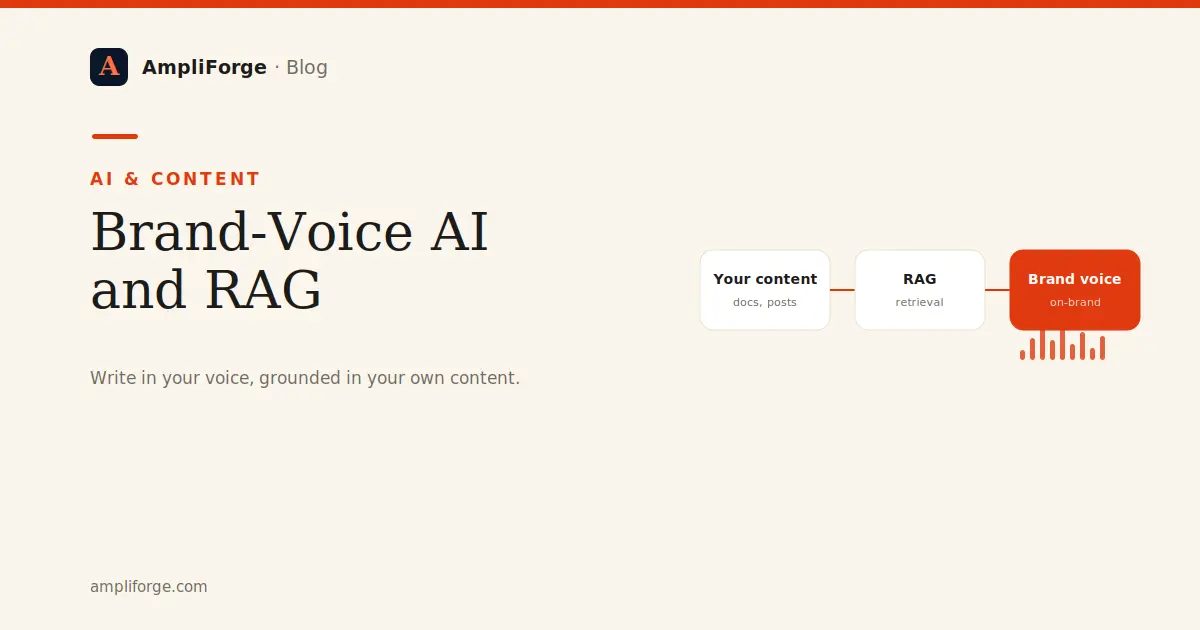
Brand-voice AI is generative AI grounded in your own approved content through retrieval-augmented generation (RAG). Instead of writing from generic training data, the model retrieves your real posts, documents, and guidelines, then drafts in your tone. The result reads like your team wrote it, not a chatbot.
Brand-voice AI is generative AI grounded in your own approved content through retrieval-augmented generation (RAG). Instead of writing from generic training data, the model retrieves your real posts, documents, and guidelines, then drafts in your tone. The result reads like your team wrote it, not a chatbot.
Most marketing leaders have already run the experiment: paste a rough outline into a general-purpose model, ask for a LinkedIn post, and get back something fluent, competent, and utterly forgettable. It sounds like everyone else. This article explains why that happens, what RAG actually is, and how to feed an AI system enough of your real voice that its output becomes usable rather than embarrassing.
Why does AI content sound generic?
A large language model writes from statistical patterns learned across the public internet. When you give it a thin prompt — write a post about content marketing — it fills the gaps with the most probable phrasing across millions of documents. The most probable phrasing is, by definition, the most average. That average is what we recognize as AI voice: tidy, hedged, and anonymous.
Your brand voice is the opposite of average. It carries specific opinions, a characteristic sentence rhythm, words you favor and words you ban, and a point of view your audience has learned to recognize. None of that lives in the model's general training data, so the model cannot reproduce it. It can only guess at a plausible default.
Prompt engineering helps a little. You can tell the model to write in a confident, concise B2B tone, and it will shift in that direction. But adjectives are a weak substitute for evidence. Confident and concise means one thing to your CFO and another to your model. Until the system can see concrete examples of how your company actually writes, it is improvising.
This is the core problem brand-voice AI solves: replacing vague instructions with retrieved evidence.
What is RAG (retrieval-augmented generation)?
Retrieval-augmented generation is a technique that connects a language model to an external library of your own content. Before the model writes anything, a retrieval step searches that library for the passages most relevant to the task, and those passages are inserted into the prompt as grounding. The model then generates its answer conditioned on your material rather than on generic priors.
The name describes the two stages. Retrieval finds the right source passages. Generation writes the output using them. RAG is the bridge between the two.
How retrieval actually works
Your approved content — past posts, web pages, transcripts, product docs, style guides — is split into chunks and converted into numerical representations called embeddings, which capture meaning rather than exact wording. They are stored in a vector index. When a new task arrives, the system embeds the task, finds the chunks whose meaning sits closest to it, and hands those chunks to the model as context.
The practical effect: when the AI drafts a post about, say, attribution, it is not recalling the internet's average take on attribution. It is looking at how your company has written about attribution before — your framing, your examples, your preferred terms — and continuing in that line.
Two things follow from this. First, grounded output is more accurate, because it draws on your facts instead of inventing plausible ones. Second, it is more on-brand, because the retrieved passages carry your voice into the generation step. RAG is how a content supply chain keeps quality consistent as it scales one source asset into weeks of distribution-ready material.
Is RAG different from fine-tuning?
Yes, and the difference matters for anyone weighing options. Fine-tuning retrains the model's weights on your data, which is expensive, slow to update, and hard to audit — and it bakes your content into a model you may not fully control. RAG leaves the model untouched and keeps your content in a library you own and can edit at any time. Publish a new flagship post today, add it to the library, and the next draft can already reflect it. Retract something off-brand, remove it from the library, and it stops influencing output immediately. For a fast-moving marketing team, that editability is usually worth more than the marginal fluency fine-tuning can add.
How do you feed an AI your brand voice?
Capturing brand voice is a curation problem before it is a technical one. The model can only retrieve what you give it, so the quality of your inputs sets the ceiling on the quality of the output. Feed it your best, most representative writing — not everything you have ever published.
Use the checklist below as the source set for a brand-voice system. Aim for material that a new hire would study to learn how your company sounds.
- Ten to twenty of your best-performing posts or articles — the pieces that sound unmistakably like you and that you would be happy to see echoed.
- A written voice and tone guide — the adjectives you aim for, the ones you avoid, and a few before/after rewrites that show the difference.
- An approved vocabulary list — product names, category terms, and preferred spellings, plus a do-not-use list of words and clichés you ban.
- Founder or executive long-form — talk transcripts, webinar recordings, or podcast episodes where your point of view comes through unscripted.
- Customer-facing reference language — how you describe your product, your category, and the problem you solve, in the exact words you have signed off on.
- Two or three genuine points of view — the opinions you are willing to defend publicly, so the AI argues your positions instead of sitting on the fence.
- Formatting conventions — how you handle headlines, hooks, list length, emoji policy, and calls to action.
- Explicit negative examples — a short set of off-brand passages labeled as such, so the system learns what to move away from as well as toward.
Notice what is not on the list: volume for its own sake. A tight set of exemplary content beats a bulk dump of every email and blog post you have ever sent. Retrieval rewards signal, and noisy inputs pull the output back toward the average you were trying to escape.
Once the source set is in place, brand voice becomes a reusable asset. The same grounding that makes one post sound like you makes the next hundred sound like you, which is what lets a small team run a real B2B repurposing framework without a proportional increase in headcount.
Keeping brand-voice AI EU-safe
Grounding a model in your content means sending text to an AI service, and some of that text may contain personal data — a name in a transcript, an email address in a customer quote. The EU-safe pattern is to redact personally identifiable information (PII) before any third-party AI call, so raw personal data never leaves your controlled environment.
Be precise about what this does and does not promise. Redaction before the call is a genuine safeguard; it limits what a third-party model ever sees. It does not let you claim that third-party models never train on inputs — some providers may, depending on their terms, which is exactly why redaction matters. AmpliForge does not train its own models on customer data, and it redacts PII before every external call, keeping brand-voice generation aligned with EU data residency and GDPR expectations. The wider practice is covered in our guide to GDPR-compliant AI content and EU data residency.
Where does brand-voice AI fit your workflow?
Brand-voice AI is not a magic button that removes the human. It removes the blank page and the generic first draft, so your team spends its time editing and deciding rather than generating from scratch. The judgment about what to say, which opinion to take, and when a draft is ready to ship stays with people.
Positioned that way, it becomes a throughput multiplier. One well-grounded system turns a single webinar or long-form asset into a steady stream of on-brand posts, each recognizably yours, each ready for a human editor's final pass. That is the difference between using AI to save time and using it to sound like everyone else. To see how brand-voice generation fits an end-to-end content operating system, start at the AmpliForge home page or compare the approach with point tools.
Frequently asked questions
What is the difference between RAG and fine-tuning for brand voice?
RAG retrieves passages from a content library you own and feeds them to the model at generation time, so you can update your voice by editing the library. Fine-tuning retrains the model's weights, which is slower, costlier, and harder to change. For most marketing teams, RAG is the more practical and auditable choice.
How much content do I need to capture my brand voice?
Quality beats quantity. Ten to twenty of your best-performing, most representative pieces, plus a voice guide and an approved vocabulary list, will outperform a bulk dump of everything you have ever published. Noisy inputs pull output back toward the generic average you are trying to avoid.
Is brand-voice AI safe under GDPR if my content contains personal data?
It can be, if PII is redacted before any third-party AI call so raw personal data never leaves your controlled environment. Note that some third-party models may train on inputs, which is why redaction matters. AmpliForge does not train its own models on customer data and keeps generation aligned with EU data residency and GDPR.
Ralf Paschen
Founder, AmpliForge GmbH
Ralf Paschen is the founder of AmpliForge GmbH, the software company behind the AmpliForge platform. During three CMO appointments across enterprise B2B SaaS organizations, he encountered the same recurring problem: strong content was created once and then left underused, repeatedly rebuilt from scratch rather than repurposed across channels and formats. That gap became the founding premise for AmpliForge. Before founding the company, Ralf spent more than 20 years in enterprise software go-to-market roles across the US, EMEA, and DACH markets, including senior positions at Broadcom, CA Technologies, Automic, and Novell. His track record includes 25% revenue growth and 30% pipeline growth at Broadcom, 60% of marketing-sourced pipeline at xtype, and an earlier 300% increase in lead generation at an enterprise software business. Ralf holds an MIT Professional Education certification in Designing and Building AI Products and Services, which informs AmpliForge's approach to applying artificial intelligence to content repurposing at scale. He is the author of Stop Prompting, available on Amazon.