Content Strategy
Why 86% of Blog Content Underperforms in 2026 (And What Still Works)

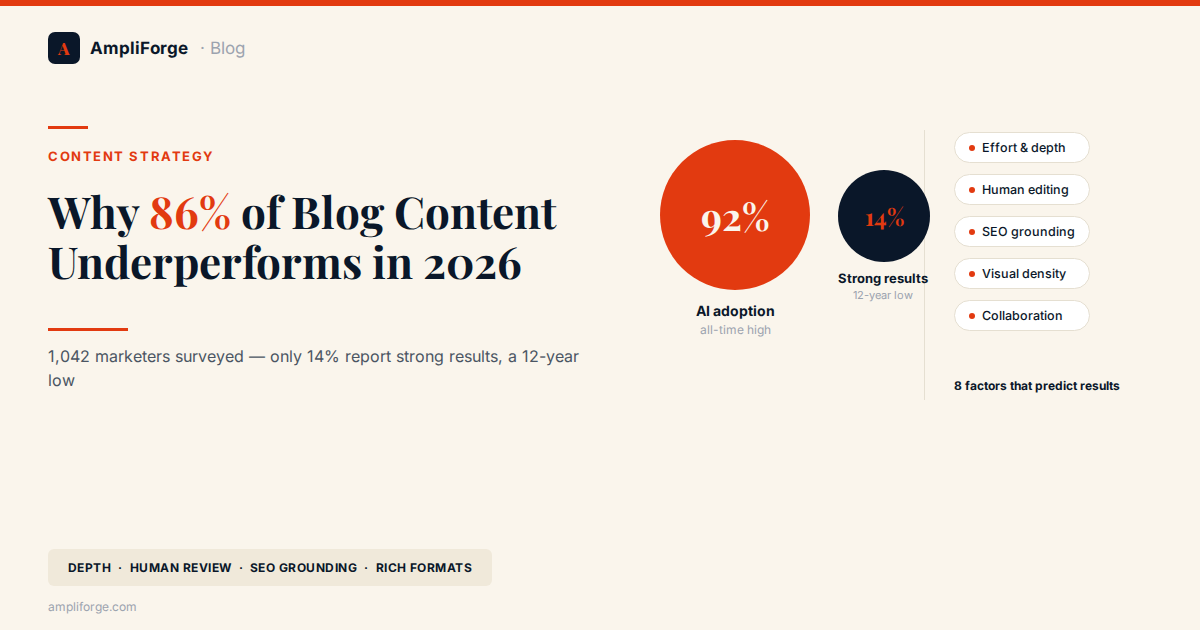
Orbit Media's 2026 survey of 1,042 marketers found only 14% report strong blog results — a 12-year low — despite 92% now using AI. Eight factors actually predict performance: depth, human editing, SEO grounding, and rich formats among them. AmpliForge's generation pipeline is built around exactly these.
Most B2B content teams are producing more than ever and getting less from it. That's not a hot take — it's the headline finding from Orbit Media's 13th annual content marketing survey, which asked 1,042 marketers 24 questions about how they create, promote, and measure content. Only 14% now report "strong results" from their blog — the lowest figure in the survey's 12-year history, down from a historical range of 20–30%. Another 18% aren't even sure their blog works at all.
The strange part: this is happening at the exact moment AI adoption peaked. 92% of marketers now use AI in their content process. If AI made content better, this should be the best year on record. It's the worst.
What does the new data say about AI and blog performance?
AI adoption hit 92% while strong results fell to a 12-year low of 14%, proving usage alone doesn't improve outcomes. AI cut average writing time from 4 hours 10 minutes (the 2022 peak) down to 3 hours 20 minutes — a real efficiency gain. But faster production tracked with worse results, not better. As Ann Handley put it in the original piece: "We need to be much more discerning about which effort we remove, and which we keep."
Why did content get worse even as AI made it faster?
AI removed effort exactly where effort was doing the work. The survey's data shows teams used their AI-driven time savings to publish more, thinner content rather than fewer, deeper pieces. Average blog post length actually dropped, from 1,427 words in 2023 to 1,312 words in 2026. Speed went up. Substance went down. The two aren't the same axis, and treating them as one is the core mistake the data exposes.
What actually separates high performers from the rest?
Andy Crestodina's analysis identifies eight tactics that correlate with strong results:
- Effort — longer, more thoroughly developed pieces outperform rushed ones
- Collaboration — content built with outside experts/influencers shows 2.6x better results than the benchmark
- Visual density — images and multimedia formats drive engagement
- Keyword research — SEO fundamentals still matter, even in an AI-search world
- Format — webinars and original research reports outperform plain blog posts
- Original research — publishing proprietary data delivers a 50% performance boost over generic content
- Human editing — human-edited content performs nearly 2x better than AI-edited content
- Paid promotion — paid channels now outperform free organic distribution
Programs using six or more of these eight tactics are three times more likely to report strong results. Zero respondents in the survey execute all eight.
How is AmpliForge built around these factors?
We didn't design AmpliForge around this specific survey — it's been out for one release cycle. But the architecture happens to enforce several of the same disciplines the data says separate high performers from the rest, because they were the right defaults independent of this study.
| Factor | AmpliForge |
|---|---|
| Effort over speed | Piece count is insight-driven, not a manual stepper — the system derives how much content a set of source insights can actually support, rather than letting volume outrun substance |
| Human editing | Every piece goes through a mandatory human approval step before publishing, on every plan — never a premium add-on |
| Keyword research | SEO blocks are grounded in real scraped keyword and competitor data, not model guesswork |
| Visual density & format | Native support for blog, LinkedIn, newsletter, email, Carousel/Document, Social Clip, and Audiogram — not just text with one bolted-on image |
| Collaboration | Not built yet — no expert/influencer co-creation workflow exists today |
| Original research | Not built yet — content is derived from a customer's own existing assets, not original proprietary research |
| Paid promotion | Out of scope — AmpliForge handles organic distribution and scheduling, not paid media |
Four of the eight factors are strong matches by design. Two are real, acknowledged gaps rather than claimed strengths. That's a deliberate choice in how we're presenting this: the data is useful precisely because it's honest, and so is the comparison.
What should content teams do differently in 2026?
The survey's own conclusion is the right one: treat AI as an efficiency tool for routine tasks, not a strategy replacement. The teams still getting strong results aren't the ones who publish the most — they're the ones who kept doing the harder things AI made it tempting to skip. Depth. Human judgment. Real data. Richer formats than plain text.
That's a content operations problem before it's a tooling problem. The tooling can make the eight tactics easier to sustain at scale — it can't decide to use them for you. See how AmpliForge's brand voice system approaches grounding, or compare it against a stack of single-purpose tools.
Frequently asked questions
Why do only 14% of marketers report strong blog results in 2026?
Because most teams used AI-driven time savings to publish more content rather than better content — average post length actually declined even as AI usage rose to 92%, per Orbit Media's 2026 survey of 1,042 marketers.
Does using AI for content actually hurt performance?
Not directly — the survey found zero correlation between AI usage and results, positive or negative. The issue is what teams did with the time AI saved: most reduced effort rather than redirecting it toward the tactics that actually drive results.
What content formats perform better than a standard blog post?
Webinars and original research reports outperform plain blog posts, per the survey. Richer formats — carousels, short video, audio — also correlate with stronger engagement than plain long-form text alone.
Ralf Paschen
Founder, AmpliForge GmbH
Ralf Paschen is the founder of AmpliForge GmbH, the software company behind the AmpliForge platform. During three CMO appointments across enterprise B2B SaaS organizations, he encountered the same recurring problem: strong content was created once and then left underused, repeatedly rebuilt from scratch rather than repurposed across channels and formats. That gap became the founding premise for AmpliForge. Before founding the company, Ralf spent more than 20 years in enterprise software go-to-market roles across the US, EMEA, and DACH markets, including senior positions at Broadcom, CA Technologies, Automic, and Novell. His track record includes 25% revenue growth and 30% pipeline growth at Broadcom, 60% of marketing-sourced pipeline at xtype, and an earlier 300% increase in lead generation at an enterprise software business. Ralf holds an MIT Professional Education certification in Designing and Building AI Products and Services, which informs AmpliForge's approach to applying artificial intelligence to content repurposing at scale. He is the author of Stop Prompting, available on Amazon.