GTM Content Strategy
Transform Expert Knowledge into Distribution-Ready GTM Content at Scale

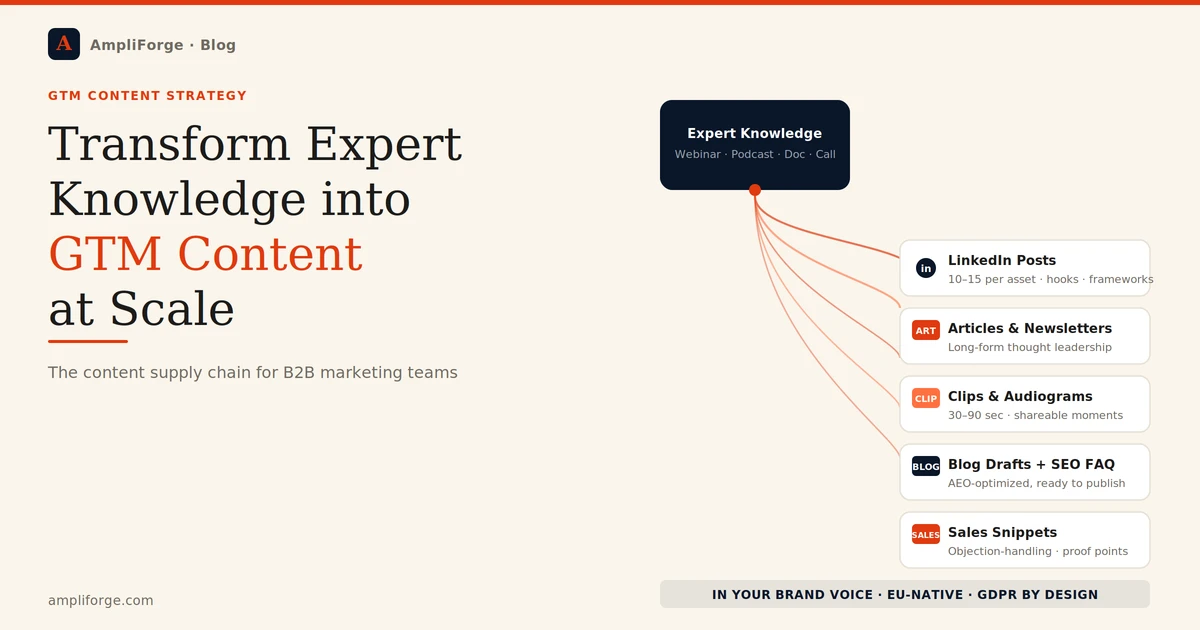
A content supply chain transforms expert knowledge artifacts — webinars, podcasts, documents — into distribution-ready GTM content at scale by systematically extracting insights and generating every format your go-to-market motion requires, grounded in your brand voice.
Expert knowledge is the most underused asset in B2B marketing. Your team runs webinars, records podcasts, joins sales calls, and produces internal briefings packed with insight that took years to develop. Most of that knowledge never reaches your market at scale. The problem is not a lack of expertise — it is the absence of a systematic way to transform expert knowledge into distribution-ready GTM content.
What does "transform expert knowledge into GTM content" actually mean?
GTM content — go-to-market content — is the material that moves prospects through awareness, consideration, and decision. LinkedIn posts that trigger conversations. Articles that rank for competitive keywords. Newsletters that keep customers engaged between renewals. Sales snippets that give your team a sharper story. This content does not come from generic AI prompts. It comes from expertise: the frameworks your team has built, the objections they have heard a hundred times, the data points that stop prospects mid-scroll.
Transforming expert knowledge into GTM content means capturing that expertise at the source — a webinar, a podcast recording, a strategy document — extracting the insight that makes it valuable, and systematically producing every format your go-to-market motion requires, all grounded in the thinking that makes your team credible.
Why most B2B teams fail at this?
The standard approach is manual and linear. A CMO records a webinar. The recording sits in a folder. Someone extracts one clip for LinkedIn. The rest is forgotten. The expertise was there; the system to amplify it was not.
The bottleneck is not knowledge — it is extraction and distribution. Skilled marketers spend most of their time on production work that could be systematized: transcribing, reformatting, writing variants for different channels, scheduling, and measuring. Time spent on production is time not spent on strategy, positioning, and the expertise itself.
This is the core problem a content supply chain solves.
What is a content supply chain for GTM?
A content supply chain is a systematic pipeline that carries one source asset from ingestion through to published, measured GTM content. It is not a single tool — it is a sequence of steps where each stage adds value and passes the output to the next:
Source → Bring in the expert knowledge artifact: a webinar recording, podcast episode, sales call, internal presentation, or document.
Extract → AI identifies the insights, frameworks, quotes, data points, and hooks that make the asset valuable. Not summarization — structured insight extraction.
Generate → Each insight becomes multiple pieces of GTM content: LinkedIn posts, articles, newsletters, blog drafts, audiograms, quote cards. Every piece is grounded in your brand voice through retrieval-augmented generation — your actual published content, not a generic style prompt.
Distribute → Content moves into a queue for review, approval, and publishing — including direct to LinkedIn for B2B teams.
Analyze → Engagement data flows back: what performed, what drove clicks, what the audience saved and shared.
Attribute → CTA and UTM tracking connects distributed content to pipeline. You know which webinar clip drove which demo request.
This six-stage pipeline is what turns a single expert knowledge artifact into weeks of distribution-ready GTM content at scale.
The GTM content types a content supply chain produces
From one 60-minute webinar, a systematized content supply chain can generate:
- 10–15 LinkedIn posts (hooks, frameworks, contrarian takes, data points)
- 2–3 LinkedIn articles (long-form thought leadership)
- 1 newsletter issue
- 1 blog draft with AEO-optimized FAQ
- 3–5 social clips and audiograms (30–90 seconds)
- Quote cards for the strongest moments
- Sales snippets repurposed from objection-handling segments
Every piece is grounded in the same expert knowledge. None of it sounds generic because it is not — it is extracted from the specific insight your team produced, in your specific voice.
Why brand voice is non-negotiable for GTM content?
Generic AI content is the fastest way to erode the trust you have built. Your prospects can tell when a LinkedIn post was written by a prompt and when it was written by someone who has spent years in the problem space. Brand voice — the specific vocabulary, sentence rhythm, and perspective that makes your content recognizable — is the signal that separates credible GTM content from noise.
The right approach is retrieval-augmented generation: the system retrieves your own best-performing published content and uses it as the style reference for every new piece it produces. The model generates in your voice because it is grounded in your actual voice, not in a generic instruction to "sound professional."
EU considerations for B2B GTM content at scale
For B2B teams in the DACH region and across the EU, two regulatory requirements are directly relevant when using AI to process expert knowledge at scale.
First, GDPR. Webinars, podcasts, and sales calls contain personal data — speaker names, customer mentions, company-specific information. Any AI system that processes this content must handle it under a Data Processing Agreement (Art. 28 GDPR) and must not transmit personal identifiers to third-party AI providers without appropriate safeguards. The right technical control is PII redaction at the processing boundary: names and identifiers are removed before any content reaches a language model, and restored only on EU infrastructure after processing.
Second, EU AI Act Article 50. From 2 August 2026, AI-generated content that could be mistaken for human-produced content must carry a machine-readable disclosure. For GTM content produced at scale, this means every generated piece must be marked as AI-generated at the point of creation — not as an afterthought, but as a structural property of the output.
Both requirements favor platforms built in the EU from the ground up, where data residency, DPA coverage, and AI Act labeling are architectural defaults rather than compliance add-ons.
How to get started: the expert knowledge audit
Before you build or buy a content supply chain, run a simple audit of your existing expert knowledge artifacts:
1. List every recorded asset from the last 12 months. Webinars, podcasts, internal all-hands recordings, conference talks, product demos. Most teams discover they have 20–40 hours of recorded expert content sitting unused.
2. Identify the five highest-insight recordings. Which session contained the sharpest frameworks? The most compelling data? The strongest objection-handling? Start there.
3. Calculate the GTM content gap. How many LinkedIn posts did your team publish last month? How many could you have published if every insight from those five recordings had been extracted and formatted? The gap between those two numbers is your amplification opportunity.
4. Choose one asset and run it through a systematic extraction. Take the transcript of your best webinar. Identify the five strongest insight units. Write one LinkedIn post from each. That is the manual version of what a content supply chain automates — and doing it once makes the value of automation immediately concrete.
The shift from content creation to content amplification
The strategic reframe that makes this work is moving from content creation to content amplification. Content creation asks: what should we write? Content amplification asks: what expert knowledge do we already have, and how do we make sure it reaches every audience segment, in every relevant format, on every channel where our buyers are active?
This shift is significant for B2B marketing teams because it changes where creative energy goes. Instead of starting from a blank page, you start from a rich source of validated expertise. The creative work becomes curation, sharpening, and positioning — not production from scratch.
At scale, this is the difference between a marketing team that publishes 5 pieces a month and one that publishes 40 — not because they hired more people, but because they systematized the transformation of expert knowledge into GTM content.
That is what a content supply chain makes possible. See how AmpliForge compares to point tools built for a single step of that pipeline.
Frequently asked questions
What is the difference between content creation and content amplification?
Content creation starts from a blank page. Content amplification starts from existing expert knowledge — webinars, podcasts, documents — and systematically transforms it into every GTM format needed. The expertise already exists; amplification is the system that distributes it.
How does GDPR apply when using AI to process expert knowledge in the EU?
Any AI system processing webinars, podcasts, or sales calls must operate under an Art. 28 GDPR Data Processing Agreement. Personal identifiers should be redacted at the processing boundary before reaching any language model, and restored only on EU infrastructure after processing.
How many pieces of content can you realistically produce from one webinar?
A systematized content supply chain can produce 10–15 LinkedIn posts, 2–3 articles, a newsletter, a blog draft, 3–5 clips and audiograms, plus quote cards and sales snippets from a single 60-minute webinar — all in your brand voice.
Ralf Paschen
Founder, AmpliForge GmbH
Ralf Paschen is the founder of AmpliForge GmbH, the software company behind the AmpliForge platform. During three CMO appointments across enterprise B2B SaaS organizations, he encountered the same recurring problem: strong content was created once and then left underused, repeatedly rebuilt from scratch rather than repurposed across channels and formats. That gap became the founding premise for AmpliForge. Before founding the company, Ralf spent more than 20 years in enterprise software go-to-market roles across the US, EMEA, and DACH markets, including senior positions at Broadcom, CA Technologies, Automic, and Novell. His track record includes 25% revenue growth and 30% pipeline growth at Broadcom, 60% of marketing-sourced pipeline at xtype, and an earlier 300% increase in lead generation at an enterprise software business. Ralf holds an MIT Professional Education certification in Designing and Building AI Products and Services, which informs AmpliForge's approach to applying artificial intelligence to content repurposing at scale. He is the author of Stop Prompting, available on Amazon.