EU & compliance
AI Content Privacy: What "We Deleted Your File" Doesn't Cover

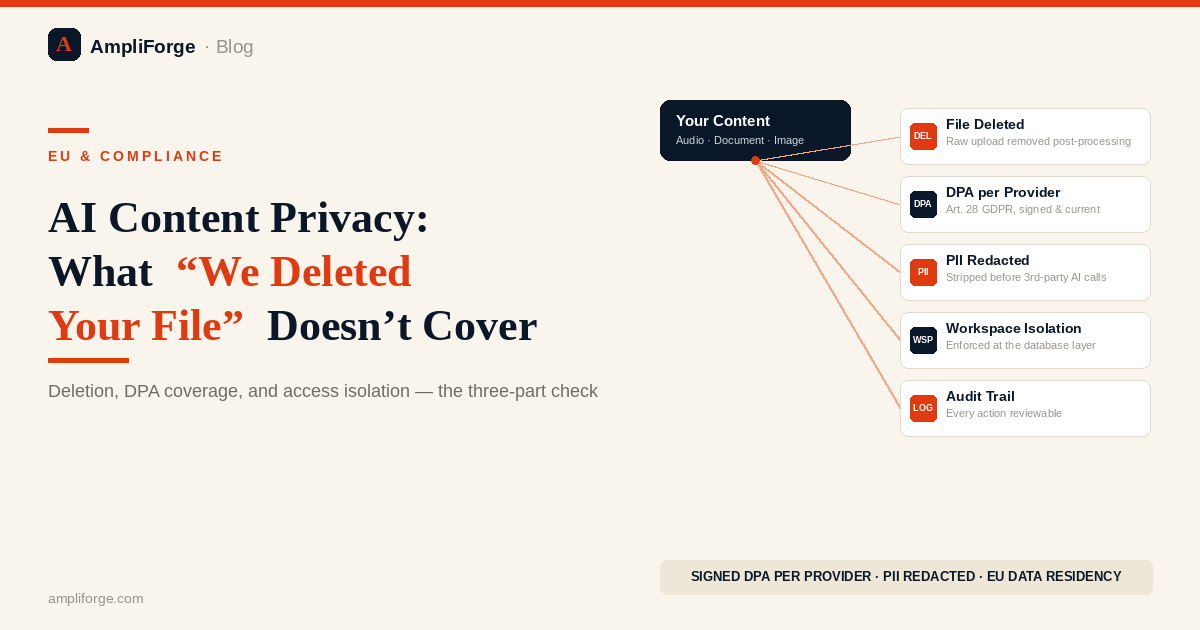
A privacy claim from an AI content tool only means something if it covers three things: what happens to the content after the file is gone, which data processing agreement governs every third-party AI call in the pipeline, and how access is isolated once more than one person uses the account. Most tools answer only the first.
A privacy claim from an AI content tool only means something if it covers three things: what happens to the content after the file is gone, which data processing agreement governs every third-party AI call made on your behalf, and how access is isolated once more than one person uses the account. Most tools in this category answer only the first — and stop there.
What does a privacy answer from an AI content tool actually need to cover?
A complete answer needs three layers: deletion of the raw file, documented processing terms for every AI provider the request touches, and access isolation for whoever can see the output afterward. Ask any AI content tool "is my content private?" and the response is usually one fact restated — the uploaded file gets deleted once processing finishes. That's true, and it's also the easiest layer to solve, which is exactly why it's the one most FAQs stop at. A tool that only addresses deletion has answered the easiest third of the question, not the whole thing.
Why isn't "we delete your file after processing" a privacy policy?
Deleting a raw upload after processing is basic hygiene, not a privacy guarantee — and it only ever covers the file, never what was derived from it. Leaving uploads sitting in storage indefinitely would be actively worse, so removing them clears the floor a product has to clear just to be reasonable. The transcript generated from an audio file doesn't disappear when the file does. Neither does the request log, or whatever retention window the model provider applies on its own end. A privacy answer that stops at "we deleted the input" has drawn its boundary exactly where the harder questions start.
What is a Data Processing Agreement, and why does every AI call in the pipeline need one?
A Data Processing Agreement (Art. 28 GDPR) is a signed contract defining what a processor can do with personal data on a controller's behalf — and every third-party AI provider a request is routed through is a separate processor that needs its own. A content tool that transcribes audio, reads a document, or generates an image usually isn't doing that work itself; it's calling one or more external AI providers per request. "We call an AI API" is a supply chain, and a supply chain without a signed agreement at every link isn't compliant just because the product wrapping it looks finished.
The stronger technical control sits above the paperwork: redacting personal identifiers — names, company references, anything identifying — before a request ever leaves for a third-party model, and restoring them only after the response returns, on infrastructure the operator actually controls. That has to be a structural decision made at build time, not a setting added later.
Why does account structure matter for privacy?
A tool built around one login and a single shared history has no access model — it has the absence of one, because there was never more than one workspace to isolate. That gap stays invisible for exactly as long as one person is the only one touching the account. The moment a second person needs in — a team member, a contractor, a client checking their own project — the only options are sharing the login outright or granting no access at all, because nothing in the product was built to separate one person's content from another's.
| What "private" needs to answer | Typical single-purpose AI tool | Content operating system |
|---|---|---|
| File deletion | Raw upload removed after processing | Raw upload removed after processing |
| Processing terms | Not addressed — provider defaults apply silently | Signed DPA with every AI provider in the pipeline, checked and current |
| PII exposure to third-party models | Not addressed | Identifiers redacted before any third-party call, restored only after, on controlled infrastructure |
| Access isolation | One login, one shared history — no workspace concept | Workspace-scoped access enforced at the database level |
| Audit trail | Not addressed | Actions on client content are logged and reviewable |
The three questions that separate a real privacy answer from a reassuring one
Before trusting any AI tool with content that belongs to someone else — a client's recording, a prospect's brand deck, a colleague's draft — three follow-up questions tell you which kind of answer you actually got:
1. Deleted from where, specifically? The file, yes — but also provider-side logs, caches, and any backup that ran before the deletion job.
2. What data processing agreement covers each AI provider in the pipeline? Not "we use AI responsibly" — the actual signed agreement, per provider, per processing step.
3. If two people need access to the same account, what stops one from seeing the other's history? If the honest answer is "nothing, they'd share the login," there is no access model — just an account.
Most tools in this category answer the first question well and run out of specifics by the second. AmpliForge is built to answer all three the same way regardless of who's asking: retention under a documented policy rather than a hope that deletion was enough, a signed DPA behind every model call in the pipeline, and workspace isolation enforced where it can't be bypassed by a shared password. See how EU data residency and DPA coverage work end to end, or compare this against a stack of single-purpose tools.
Frequently asked questions
Is deleting my uploaded file after processing the same as data privacy?
No. File deletion addresses the raw input only. It says nothing about the transcript or output generated from it, the data processing agreements covering the AI providers that touched it, or who else can access it afterward — the three things a full privacy answer needs to cover.
What is a Data Processing Agreement and why does it matter for AI content tools?
A DPA (Art. 28 GDPR) is a signed agreement defining what a processor can do with personal data. Every third-party AI provider a tool routes a request through — transcription, vision, image generation — is a separate processor and needs its own DPA, not just the front-end product.
Can multiple people safely share one AI content tool account?
Only if the tool has a real access model. A single login with one shared history has no workspace boundary — a second user gets full visibility into everything the first user produced, because there's no isolation layer to prevent it.
Ralf Paschen
Founder, AmpliForge GmbH
Ralf Paschen is the founder of AmpliForge GmbH, the software company behind the AmpliForge platform. During three CMO appointments across enterprise B2B SaaS organizations, he encountered the same recurring problem: strong content was created once and then left underused, repeatedly rebuilt from scratch rather than repurposed across channels and formats. That gap became the founding premise for AmpliForge. Before founding the company, Ralf spent more than 20 years in enterprise software go-to-market roles across the US, EMEA, and DACH markets, including senior positions at Broadcom, CA Technologies, Automic, and Novell. His track record includes 25% revenue growth and 30% pipeline growth at Broadcom, 60% of marketing-sourced pipeline at xtype, and an earlier 300% increase in lead generation at an enterprise software business. Ralf holds an MIT Professional Education certification in Designing and Building AI Products and Services, which informs AmpliForge's approach to applying artificial intelligence to content repurposing at scale. He is the author of Stop Prompting, available on Amazon.